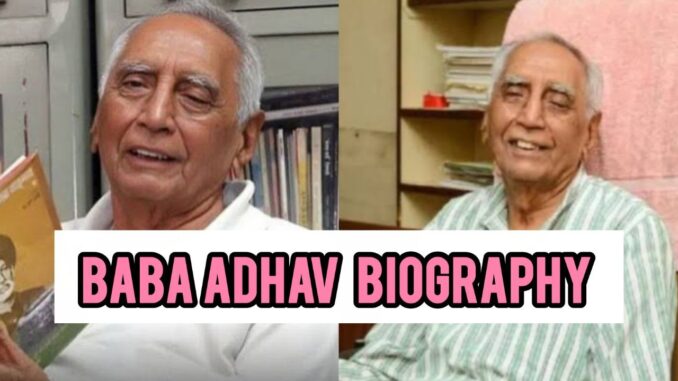
Baba Adhav Biography
Baba Adhav was born on June 1 1930 in Pune, Maharashtra, India. He grew up in a working-class part of the city and spent his childhood seeing how poor people lived and worked. As a young man he studied Ayurveda and became a trained ayurvedic practitioner. He opened a small clinic in Nana Peth, Pune, where he met many market workers and hamals — the head-loaders who carried heavy goods in the city’s markets. These early encounters changed the direction of his life: seeing the harsh daily reality of hamals pushed him from medical practice into full-time social activism. Baba Adhav was 95 years old as of 2025.
He read the ideas of Mahatma Gandhi, Jyotirao Phule and B. R. Ambedkar, and he believed that social reform must combine economic justice with the fight against caste and discrimination. He became known simply as “Baba” to those he helped — a respectful name that also spoke to his moral authority in the city’s working-class neighbourhoods. Over time his influence grew beyond Pune to shape labour practice and law across Maharashtra.
Baba Adhav Career
Baba Adhav’s public work began when he organised hamals into a union called the Hamal Panchayat. He built that union slowly, worker by worker, and used collective action to demand better pay, safer working hours and legal recognition. The hamals’ first major strike in 1956 led to arrests and satyagrahas, but it proved the power of organised protest and ultimately pushed authorities to take the workers’ demands seriously. Those early struggles set the stage for larger victories later in the 1960s.
A major achievement tied to Adhav’s work is the Maharashtra Mathadi, Hamal and Other Manual Workers (Regulation of Employment and Welfare) Act of 1969. This law was the country’s first substantial effort to protect manual and informal workers, providing social security, minimum wages and a framework for welfare boards. The act grew from decades of organised campaigning and is widely seen as a model that inspired similar protections in other states. Adhav and the Hamal Panchayat are regularly credited in historical accounts as important catalysts for this change.
Adhav did not stop at one union. Over the decades he helped organise rickshaw drivers, ragpickers, street vendors, domestic workers and construction labourers into groups that could press for rights. He also built practical institutions to support poor workers: free clinics, a secondary school for children of labourers and a housing colony for needy families.
One of his best-known projects is Kashtachi Bhakar, a community kitchen started in the 1970s that offered nutritious, very cheap meals to thousands every day. The kitchen was built on a no-profit, no-loss model and became a lifeline for many who earned little and had no security. Local media and community histories record that Kashtachi Bhakar fed as many as 15,000–20,000 workers on busy days.
Adhav’s activism extended into public protest and civil disobedience. He was jailed many times for his role in strikes and agitations — reports say he was arrested more than fifty times, beginning with a 1952 satyagraha against high food prices. Even into old age he remained active in protests and public campaigns, joining hunger strikes and demonstrations when he felt injustice persisted. His public record was one of persistent, often personal sacrifice for the cause of the poor.
Throughout his career he refused personal enrichment from his movement. Biographical accounts say he never owned significant property and limited his own salary to no more than a few times that of the lowest-paid worker in his union. This personal austerity helped make his leadership credible to the people he served. His ideology linked labour rights to wider social reform: he founded the Vishamta Nirmoolan Samiti (Society for the Eradication of Inequality) and promoted campaigns like “One Village — One Water Point” to fight caste-based exclusion from basic resources.
Baba Adhav Personal Life
Baba Adhav married Sheela (Shilatai) Adhav in 1966. She worked as a nurse and stood by him through decades of activism. The couple raised two sons, Aseem (also spelled Asim) and Amber, and later welcomed grandchildren. Even as his public life drew attention, Adhav kept many personal details private and lived simply with a focus on service. Friends and colleagues describe him as a man of strict personal discipline, deeply committed to his values and to the welfare of the least powerful. His modest lifestyle and refusal to accumulate wealth became as much a part of his public identity as his organising work.
Leaders from across India spoke warmly of him after his passing. Political figures, social activists and ordinary citizens paid tribute, saying his life taught the importance of dignity of labour, collective action and moral integrity. Tributes noted his ability to marry grassroots organising with social reform, making him not just a labour leader but a social teacher for many movements that followed.
Baba Adhav Death
In late 2025 Baba Adhav’s health declined after a long battle with cancer. Medical reports and news coverage say he had been fighting multiple myeloma for several years and had recent lung and kidney complications. He was hospitalised after a sudden deterioration in his condition and was on life support for a period in the days before he died. His aide reported that he passed away in Pune on the night of 8 December 2025; medical statements cited respiratory infection and renal complications on top of his long-standing cancer, and a cardiac arrest was mentioned by close sources as the immediate event of death.
Conclusion
Baba Adhav’s life was simple in form but vast in effect. He began as an ayurvedic practitioner and turned that compassion into a lifetime of organising people who had been ignored by formal politics. Through Hamal Panchayat, Kashtachi Bhakar, school and clinic projects, and persistent campaigning for legal change, he built systems that gave dignity and protection to millions of informal workers. The 1969 Mathadi Act stands as a legislative monument to the power of his movement. Even in death, his ideas and institutions remain a practical roadmap for those who want to combine labour rights with wider social justice.
FAQ
Who was Baba Adhav and why is he famous?
Baba Adhav was a Pune-based social activist known for organising unorganised workers like head-loaders, rickshaw drivers and waste-pickers. He led the Hamal Panchayat and helped push for the Maharashtra Mathadi Act of 1969 that gave legal protection to manual workers.
What is the Hamal Panchayat and what did it do?
The Hamal Panchayat is the union Adhav built for hamals (head-loaders). It organised strikes, won recognition for workers, fought for minimum wages and created community services like schools, clinics and a food kitchen to support poor workers.
What is Kashtachi Bhakar?
Kashtachi Bhakar is the community kitchen started by Baba Adhav in the 1970s. It provided very low-cost, nutritious meals to thousands of market workers daily and operated on a no-profit, no-loss basis to keep food affordable.
When did Baba Adhav die and what was the cause?
Baba Adhav died on the night of 8 December 2025 after a prolonged illness. Reports say he had multiple myeloma (a form of cancer) and faced lung and kidney complications in the final weeks; close sources mentioned a cardiac arrest at the time of death.
What is Baba Adhav’s lasting legacy?
His main legacy is a combined record of organising informal workers into recognised unions, helping achieve the Mathadi Act that protected manual workers, and creating practical social services—kitchens, schools and clinics—that improved daily life for thousands. His life also stands as an example of simple living and deep ethical commitment in social work.

Leave a Reply